
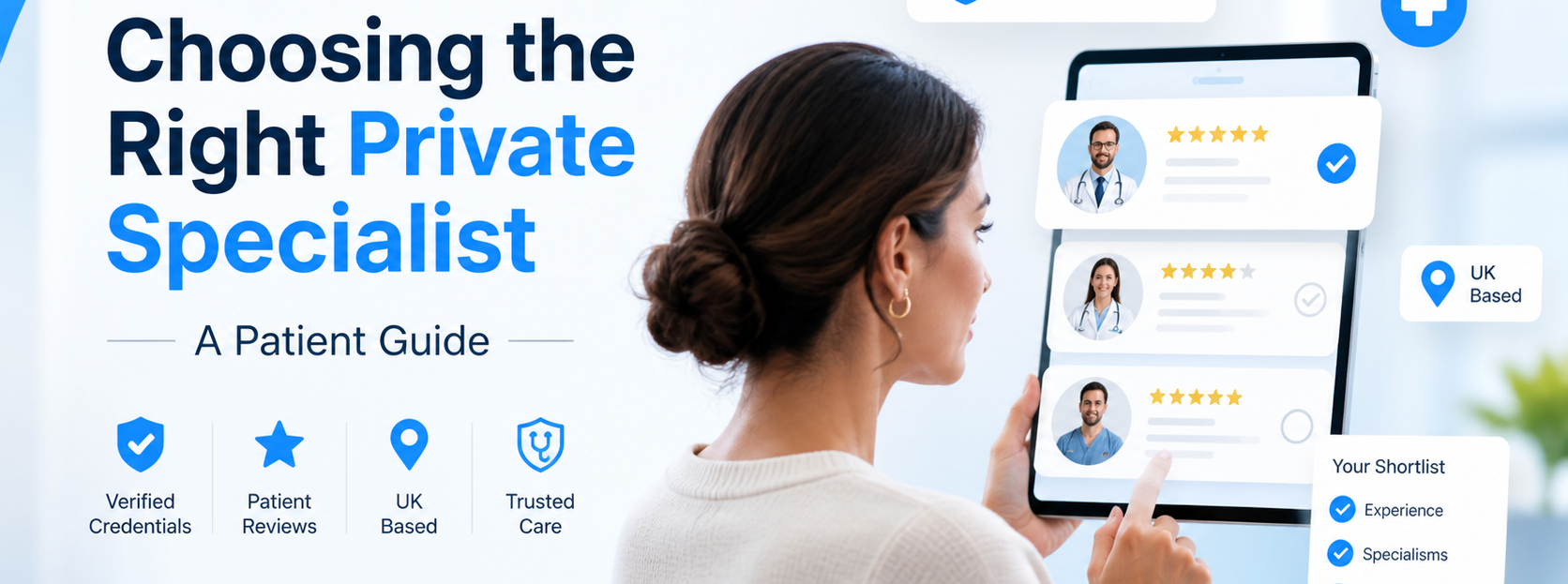
How to Choose the Right Private Specialist in the UK: A Patient Guide
Choosing the right private specialist in the UK can make a significant difference to your diagnosis, treatment options and overall experience of care. Whether you are looking for a consultant ophthalmologist, orthopaedic surgeon, cardiologist, dermatologist, gynaecologist or another medical expert, it is important to know what to check before booking an appointment.
Many patients now search online before choosing a doctor. Some use Google. Others ask AI tools such as ChatGPT, Gemini or Perplexity questions like “Who is the best private specialist near me?” or “How do I choose the right consultant for my condition?”
The best private specialist is not always the nearest doctor, the most senior doctor or the doctor with the most reviews. The right specialist is the doctor whose expertise, experience and communication style match your specific medical need.
How do I choose the right private specialist?
To choose the right private specialist in the UK, check the doctor’s qualifications, GMC registration, specialist training, clinical experience, areas of expertise, hospital affiliations, patient reviews, communication style and whether they regularly treat your specific condition or procedure.
You should also understand consultation fees, insurance recognition and follow-up arrangements before booking.
What is a private specialist?
A private specialist is usually a consultant doctor who has completed advanced training in a particular area of medicine or surgery. Many private specialists also work, or have worked, as NHS consultants.
Examples include:
- Consultant ophthalmologists for cataracts, glaucoma and retinal disease
- Consultant orthopaedic surgeons for hip, knee, shoulder and spine problems
- Consultant cardiologists for chest pain, palpitations and heart disease
- Consultant dermatologists for skin cancer, acne, eczema and mole checks
- Consultant gynaecologists for menstrual, fertility and pelvic health concerns
Importantly, doctors within the same specialty may have very different areas of expertise. For example, one orthopaedic surgeon may focus on hip replacement, while another may specialise in sports knee injuries. One ophthalmologist may specialise in cataract surgery, while another may focus on glaucoma or retinal disease.
This is why patients should look beyond the broad specialty and check whether the doctor regularly manages their specific condition.
1. Check the doctor’s qualifications and GMC registration
In the UK, doctors should be registered with the General Medical Council, commonly known as the GMC. Consultants are often also listed on the GMC Specialist Register for their specialty.
You may see qualifications after a doctor’s name, such as FRCS, MRCP, FRCOphth, MD, PhD or CCT. These can reflect specialist training, professional college membership, postgraduate research or completion of higher specialist training.
However, qualifications alone do not tell the whole story. They should be considered alongside the doctor’s clinical experience, current practice, subspecialty focus and patient feedback.
A strong specialist profile should clearly explain the doctor’s training, clinical background and areas of expertise in language that patients can understand.
2. Look for experience in your specific condition
Relevant experience matters more than a general title.
For example:
- A patient with cataracts may benefit from a surgeon who regularly performs cataract surgery
- A patient with glaucoma may need an ophthalmologist with glaucoma expertise
- A patient with hip arthritis may need a hip replacement specialist
- A patient with palpitations may need a cardiologist with rhythm expertise
- A patient with a suspicious mole may need a dermatologist experienced in skin cancer assessment
Before booking, ask yourself:
- Does this doctor regularly treat my condition?
- Do they perform the procedure I may need?
- Is this condition listed clearly on their profile?
- Do they explain their areas of expertise clearly?
- Do they offer both investigation and treatment pathways?
This is especially important for complex, recurrent or long-standing symptoms.
3. Review the doctor’s hospital and clinic affiliations
Where a specialist works can provide useful context. Some consultants practise at major NHS teaching hospitals, private hospitals, specialist centres or independent clinics.
Hospital affiliation may influence access to:
- Diagnostic tests
- Imaging facilities
- Surgical theatres
- Multidisciplinary teams
- Specialist nurses
- Follow-up care
- Emergency support arrangements
For straightforward conditions, a local private clinic may be suitable. For complex problems, it may be helpful to choose a consultant connected to a hospital or specialist centre that regularly manages similar cases.
Patients using private medical insurance should also check whether the doctor and hospital are recognised by their insurer.
4. Read patient reviews carefully
Patient reviews can be helpful, but they should be interpreted sensibly.
Reviews may give insight into:
- Whether the doctor listened carefully
- Whether explanations were clear
- Whether patients felt reassured
- Whether the consultation felt thorough
- Whether the doctor discussed treatment options properly
- Whether the overall care experience was positive
Look for patterns rather than relying on one isolated review. Repeated comments about clarity, professionalism, kindness and confidence can be useful signals.
However, a doctor with fewer reviews may still be highly experienced. Some senior consultants may have limited online reviews because they are new to private practice, mainly NHS-based, or have not actively collected patient feedback.
Patient reviews should support your decision, not replace clinical judgement.
5. Assess communication style
A good private specialist should explain your condition clearly and help you understand your options.
During a consultation, the doctor should be able to explain:
- The likely cause of your symptoms
- Whether further tests are needed
- What the diagnosis may be
- What treatment options are available
- The risks and benefits of each option
- What happens if you choose no treatment
- What follow-up is required
Good communication is especially important in private healthcare because patients are often making decisions about investigations, procedures, costs and timing.
You should leave the consultation feeling better informed, not more confused.
6. Understand costs before booking
Private healthcare costs can vary significantly depending on the doctor, hospital, location, investigation and treatment.
Before booking, check:
- Initial consultation fee
- Follow-up consultation fee
- Test or scan costs
- Procedure or surgery costs
- Hospital fees
- Anaesthetic fees, where relevant
- Insurance recognition
- Whether pre-authorisation is required
If you are self-paying, ask for a written estimate where possible. If you are using insurance, contact your insurer before the appointment to confirm whether the consultation and any tests are covered.
Transparent pricing helps avoid unexpected costs later.
7. Prepare the right questions before your appointment
A private consultation is more useful when you arrive prepared.
Useful questions include:
- What is the most likely diagnosis?
- Are further tests needed?
- What are my treatment options?
- What are the risks and benefits of treatment?
- What happens if I do nothing?
- How often do you treat this condition?
- How long is recovery likely to take?
- Will I need follow-up?
- Who should I contact if symptoms worsen?
It is also helpful to bring a list of current medications, previous test results, scan reports, operation notes and a short timeline of your symptoms.
8. Be careful when using Google or AI tools
Online information can help patients prepare for a consultation, but it should not replace medical advice.
AI tools and search engines may provide useful general information, but they do not know your full medical history, examination findings, investigation results or personal risk factors.
Use online research to ask better questions, not to diagnose yourself or choose treatment without professional guidance.
When using online information, look for content written or reviewed by qualified healthcare professionals, and be cautious about advice that sounds overly certain, promotional or not specific to your situation.
9. Choose by expertise, not just location
Convenience matters, but clinical fit matters more.
For minor or straightforward issues, a nearby specialist may be appropriate. For complex symptoms, revision surgery, rare conditions or major procedures, it may be worth travelling further to see someone with more specific expertise.
The best choice is usually the doctor who combines relevant experience, clear communication, appropriate facilities and a treatment approach that fits your needs.
How RatedDoctor helps patients find private specialists
RatedDoctor.com helps patients discover and compare private specialists by making doctor expertise clearer and easier to understand.
A RatedDoctor profile can show:
- Specialty
- Conditions treated
- Procedures performed
- Professional background
- Hospital locations
- Patient reviews
- Educational articles
- Areas of clinical expertise
As more patients use Google and AI tools to find healthcare information, clear and structured doctor profiles are becoming increasingly important. They help patients, search engines and AI platforms better understand what a specialist does and which conditions they treat.
Final takeaway
Choosing a private specialist in the UK should be based on more than a name, title, hospital or location. Patients should look for relevant expertise, specialist registration, experience with their condition, clear communication, patient feedback and transparent costs.
The right specialist should help you feel informed, supported and confident about your next step.
Find trusted private specialists by condition, procedure, location and patient reviews on RatedDoctor.com.