Professor Dan Lindfield is a Consultant Ophthalmologist and Cataract and Glaucoma Surgeon, recognised internationally for his expertise in advanced cataract surgery and glaucoma.
He works as an NHS consultant at Royal Surrey County Hospital in Guildford and leads private practices in Farnham, providing consultant-led assessment, surgery, and long-term care for patients across Surrey, Hampshire, and surrounding regions.
Patients frequently consult Professor Lindfield when searching for:
Cataract surgery near me
Glaucoma specialist near me
Advanced lens implants
Alternatives due to NHS delays or cancelled appointments
Cataract Surgery
Advanced lens technology and personalised visual outcomes
Professor Lindfield is widely recognised for expertise in modern cataract surgery, with particular experience in advanced intraocular lens technology.
Each consultation includes careful discussion of lens choice, visual expectations, and long-term eye health, allowing patients to make informed decisions tailored to their lifestyle and visual needs.
Glaucoma Care
Full-spectrum medical, laser and surgical management
Professor Lindfield provides comprehensive glaucoma care, from early diagnosis and monitoring to advanced surgical intervention.
Professor Lindfield has published extensively, with over 33 peer-reviewed articles covering cataract surgery, glaucoma, MIGS, and related ophthalmic subspecialties.
Featured in Euro Health Leaders (2024) as one of Europe’s most visionary leaders in eye care
Practice & Private Care
Professor Lindfield provides private consultations and surgery at Farnham Eye Care and Spire Clare Park Hospital, offering locally accessible care alongside his NHS consultant role in Guildford.
Patients attend from:
Farnham
Guildford
Aldershot
Fleet
Godalming
Haslemere
Wider Surrey and Hampshire regions
Appointments
Professor Lindfield sees patients for:
Cataract assessment and surgery
Glaucoma consultations and monitoring
Laser and surgical glaucoma treatments
Second opinions
Educational Video
Professor Lindfield discusses Minimally Invasive Glaucoma Surgery (MIGS)
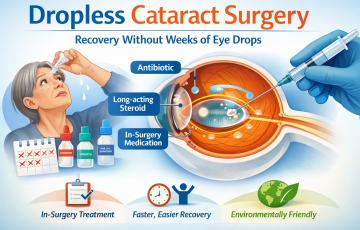
Dropless Cataract Surgery: Recovery Without Weeks of Eye Drops
By Professor Dan Lindfield
Consultant Ophthalmologist & Cataract and Glaucoma Surgeon
Based at Farnham Eye Care
What is dropless cataract surgery?
After standard cataract surgery, patients a ...
Benefits of Selective Laser Trabeculoplasty (SLT) for Glaucoma
11 Sep 2025
Why SLT (Selective Laser Trabeculoplasty) Is Becoming a First-Choice Treatment for Glaucoma
I’m Professor Dan Lindfield, and I want to share why Selective Laser Trabeculoplasty (SLT) is increasingly being seen as one of the best treatment options for open-angle ...
Professor Lindfield recently performed cataract surgery on both eyes. The care was superb at every step of the way and the outcome exceeded my most optimistic expectations. I would recommend him unreservedly.
Peter Taylor
Lovely competent staff in a pleasant environment. Efficent service and full confidence in the specialist who explains everything very clearly, is very kind and friendly and treats you like a person rather than just a pair of eyes.
SLT is a laser treatment used for open-angle glaucoma and ocular hypertension. It works by gently stimulating (or “tickling”) the cells in the trabecular meshwork (the eye’s drainage system) to improve aqueous humour outflow, which lowers intraocular pressure (IOP).
ALT (Argon Laser Trabeculoplasty) can damage the trabecular meshwork because it uses heat, leading to structural changes. Because of that, it carries a higher risk of side effects, and is now rarely used in the UK.
MLT (Micropulse Laser Trabeculoplasty) uses a laser that pulses on and off to reduce heat buildup. Its effectiveness and risks are similar to SLT, but whether it causes less inflammation is still under study.
It’s a safe and effective option that can reduce eye drops or delay their use.
After SLT, many patients can go 2 to 4 years without needing daily glaucoma medication, while achieving pressure reduction similar to one drop of medication.
It has quick recovery (often 1-2 days), is done as an outpatient procedure (no overnight stay), and takes only a few minutes per eye.
It reduces the need for more invasive eye surgery and may slow disease progression. There’s also evidence it might reduce the risk of cataract development.
MIGS (Minimally Invasive Glaucoma Surgery) refers to a group of less invasive surgical procedures for glaucoma that aim to lower intraocular pressure (IOP) by improving the drainage of fluid inside the eye, or reducing its production. These approaches are generally safer, with faster recovery, fewer complications, and often preserve more of the eye’s natural anatomy. Glaucoma UK
MIGS is generally suitable for people with mild to moderate glaucoma. It’s commonly performed along with cataract surgery, since removing a cataract can itself help reduce IOP. The eye anatomy (especially the drainage angle) and disease stage are evaluated to assess whether MIGS is a good option. Glaucoma UK
It depends. For some people, MIGS reduces IOP enough that they can reduce or even stop some eye drops, at least for a while. But this effect may only last a few years, and some medications may still be needed. Importantly, MIGS doesn’t reverse any existing damage to the optic nerve; the goal is to prevent further damage.
Dr Dan Lindfield is a Consultant Ophthalmic Surgeon providing cataract surgery in Farnham, Surrey. He is based at Farnham Eye Care and offers consultant-led assessment, modern cataract surgery, and personalised lens selection for local patients.
Cataract consultations and treatment with Dr Dan Lindfield are provided at Farnham Eye Care in Farnham, Surrey. This location is convenient for patients from Farnham and nearby Surrey and Hampshire towns seeking private cataract surgery.
Yes. Dr Lindfield discusses lens options, including lens upgrades and toric lenses for astigmatism, where clinically appropriate. All options are explained clearly so patients can make informed decisions based on their visual needs and lifestyle.
Yes. Many patients consult Dr Lindfield privately after experiencing delayed or cancelled NHS cataract appointments. Private consultation allows timely assessment, treatment planning, and continuity of care with a consultant ophthalmic surgeon.
Common symptoms include blurred or cloudy vision, glare or halos around lights, difficulty driving at night, and reduced contrast or colour clarity. A consultation with Dr Lindfield can confirm whether cataract surgery is appropriate.
Yes. Dr Lindfield performs YAG laser capsulotomy at Farnham Eye Care for patients with posterior capsule opacification (PCO) causing blurred vision after cataract surgery.
Yes. Dr Lindfield provides glaucoma assessment, monitoring, and treatment for patients in Farnham and surrounding Surrey and Hampshire areas, including medical management, SLT laser treatment, and minimally invasive glaucoma surgery (MIGS).
Yes. Dr Lindfield provides glaucoma assessment, monitoring, and treatment for patients in Farnham and surrounding Surrey and Hampshire areas, including medical management, SLT laser treatment, and minimally invasive glaucoma surgery (MIGS).
Dropless cataract surgery is an approach where key medications are given during the cataract operation, reducing or sometimes removing the need for routine post-operative medicated eye drops. The aim is fewer drops, for fewer days, while maintaining safety and effectiveness.
Not always. Many patients require fewer drops, and some may not need routine antibiotic or steroid drops. However, lubricating drops for comfort or pressure-lowering drops may still be advised in certain cases. The plan is individualised.
For carefully selected patients, outcomes are comparable to traditional drop-based regimens. Safety relies on appropriate patient selection, informed consent, and post-operative monitoring, particularly of eye pressure.
Yes. In the UK, standard cataract care already includes an intracameral antibiotic at the time of surgery. This is recommended by National Institute for Health and Care Excellence (NICE) to reduce the risk of endophthalmitis, a serious eye infection.
Yes, in some patients. Long-acting steroids can cause a rise in intraocular pressure, particularly in those with glaucoma or known steroid response. This is why follow-up and monitoring are important.
Reducing post-operative drops can lower plastic waste and repeat prescriptions. The Royal College of Ophthalmologists highlights sustainability as an important consideration in high-volume procedures such as cataract surgery.
Professor Dan Lindfield notes that dropless cataract surgery offers many advantages with relatively few disadvantages for appropriately selected patients, and that choice and clear explanation are essential so decisions can be personalised.
Personalised healthcare just a click away
Find and connect with the right specialist doctors.
Your appointment details have been forwarded to the doctor via email. You will receive a confirmation from them shortly. Thank you for choosing us for your healthcare needs.
We use cookies to give you the best possible experience on our website. By continuing to browse this site, you give consent for cookies to be used.
For more details please read our Cookie Policy
Manage Cookie Preferences
Strictly Necessary Cookies
These cookies are required for the website to work and cannot be switched off.
Analytical/ performance cookies
These cookies help us understand how visitors use our website by collecting anonymous information. They allow us to improve performance, identify issues, and enhance the overall user experience.
Functionality cookies
These cookies remember your preferences and settings, such as language or region, to provide a more personalised experience when you return to the website.
Targeting cookies
These cookies are used to deliver more relevant content and advertisements based on your browsing activity. They may also be used by trusted third-party partners to measure the effectiveness of advertising campaigns.