
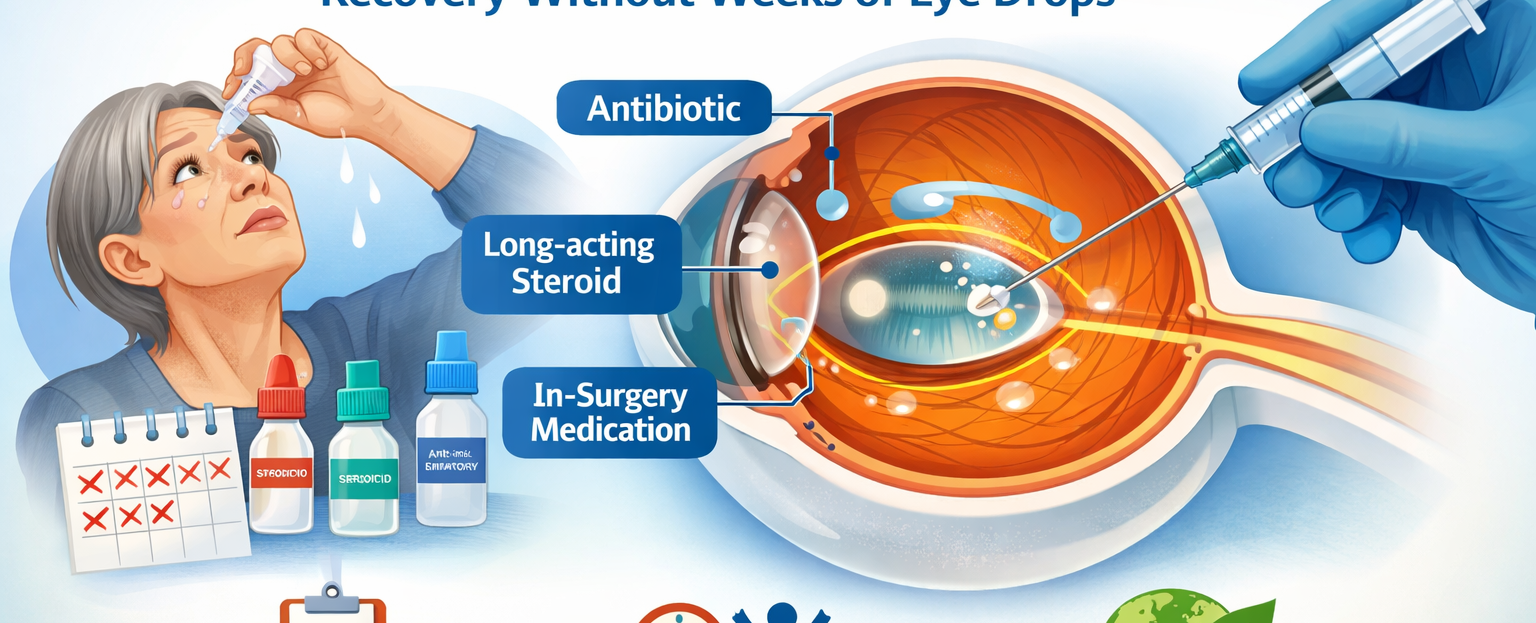
Dropless Cataract Surgery: Recovery Without Weeks of Eye Drops
By Professor Dan Lindfield
Consultant Ophthalmologist & Cataract and Glaucoma Surgeon
Based at Farnham Eye Care
What is dropless cataract surgery?
After standard cataract surgery, patients are usually asked to use multiple eye drops for 3–4 weeks — commonly an antibiotic, a steroid, and sometimes an anti-inflammatory drop. While effective, this routine can be difficult for many patients to manage consistently.
Dropless cataract surgery is an approach designed to reduce, or in some cases remove, the need for routine post-operative medicated eye drops. Instead, key medicines are delivered during the operation itself, so they are already in place when the patient goes home.
Dropless cataract surgery
Why is this approach gaining attention?
Many patients find post-operative drop schedules:
-
fiddly and stressful
-
difficult with arthritis, tremor, or poor vision in the other eye
-
challenging if they rely on family or carers
The United Kingdom & Ireland Society of Cataract and Refractive Surgeons (UKISCRS) has highlighted that traditional drop regimens can be inconvenient, costly, prone to missed doses, and have an environmental impact.
Dropless cataract surgery
Dropless approaches aim to simplify recovery while maintaining safety and effectiveness.
What actually happens during dropless cataract surgery?
The exact combination varies between hospitals and surgeons, but commonly includes:
-
Intracameral antibiotic placed inside the eye at the end of surgery
-
The National Institute for Health and Care Excellence (NICE) recommends intracameral cefuroxime to reduce the risk of endophthalmitis, a rare but serious infection. This is already standard of care in the UK.
Dropless cataract surgery
-
-
Long-acting steroid administered at the end of surgery
-
Often given as a small depot injection around the eye to control inflammation.
-
-
Anti-inflammatory medication (NSAID) in selected cases
-
Used depending on individual risk factors.
-
Even with a dropless plan, some patients may still use:
-
lubricating drops for comfort
-
pressure-lowering drops if required
The goal is usually fewer drops, for fewer days, and for some patients, no routine medicated drops at all.
Dropless cataract surgery
Why patients often prefer a “dropless” approach
From a patient perspective, the benefits are largely practical:
-
Less stress and disruption
No alarms, no complex schedules, and less anxiety about whether drops were administered correctly. -
Greater independence
Reduced reliance on family members, carers, or district nursing support. -
A smoother return to daily life
Particularly helpful for people who work, travel, or care for others. -
More reliable treatment delivery
Medicines given during surgery cannot be forgotten or missed.
Sustainability and the environmental perspective
Cataract surgery is one of the most commonly performed operations in the UK. As a result, even small changes can have a meaningful environmental impact.
The Royal College of Ophthalmologists (RCOphth) highlights that modern cataract pathways already use intracameral antibiotics, and therefore routine post-operative antibiotic drops are often unnecessary. This is reflected in their guidance on sustainable cataract surgery.
Dropless cataract surgery
Reducing post-operative drops can mean:
-
less plastic waste
-
fewer repeat prescriptions
-
lower overall environmental impact
Are there any downsides or risks?
A balanced view is essential.
UKISCRS notes that dropless approaches can achieve comparable outcomes to traditional drop regimens in many patients, but important considerations include:
Dropless cataract surgery
-
Raised eye pressure (IOP)
Long-acting steroids can increase eye pressure in some individuals, particularly those with glaucoma or known steroid sensitivity. -
Reduced flexibility
Once medication is delivered during surgery, it cannot simply be stopped if side effects occur. -
Not suitable for everyone
Patients with uveitis, significant glaucoma, certain retinal conditions, or previous complications may require a tailored plan that still includes drops. -
Licensing and consent considerations
Some steroid components may be used off-label and are governed by local protocols and informed consent.
Careful patient selection and appropriate follow-up are therefore essential.
Questions patients can ask their cataract surgeon
-
Am I a suitable candidate for a dropless or “less drops” approach?
-
What medications will be given during surgery, and what might I still need at home?
-
How will inflammation and eye pressure be monitored afterwards?
-
If drops are needed, can the regimen be simplified?
Professor Lindfield’s perspective
“Dropless cataract surgery offers many advantages and relatively few disadvantages. We are likely to see its use increase further following recent guideline changes. Most importantly, surgeons should offer patients a choice and explain both the benefits and potential drawbacks clearly, so a personalised decision can be made that suits the individual.”
Dropless cataract surgery
Key takeaway
Dropless cataract surgery is not about cutting corners. It is about making recovery easier, reducing burden on patients, and supporting more sustainable care — while keeping safety, evidence, and individualised decision-making at the centre of treatment.