
Before You Have a Knee Replacement, Ask About Mako
Patients considering knee replacement are increasingly hearing about robotic-assisted surgery. But what does the robot actually do and is it better than conventional surgery?
Mako does not perform the operation independently. The surgeon remains in control throughout.
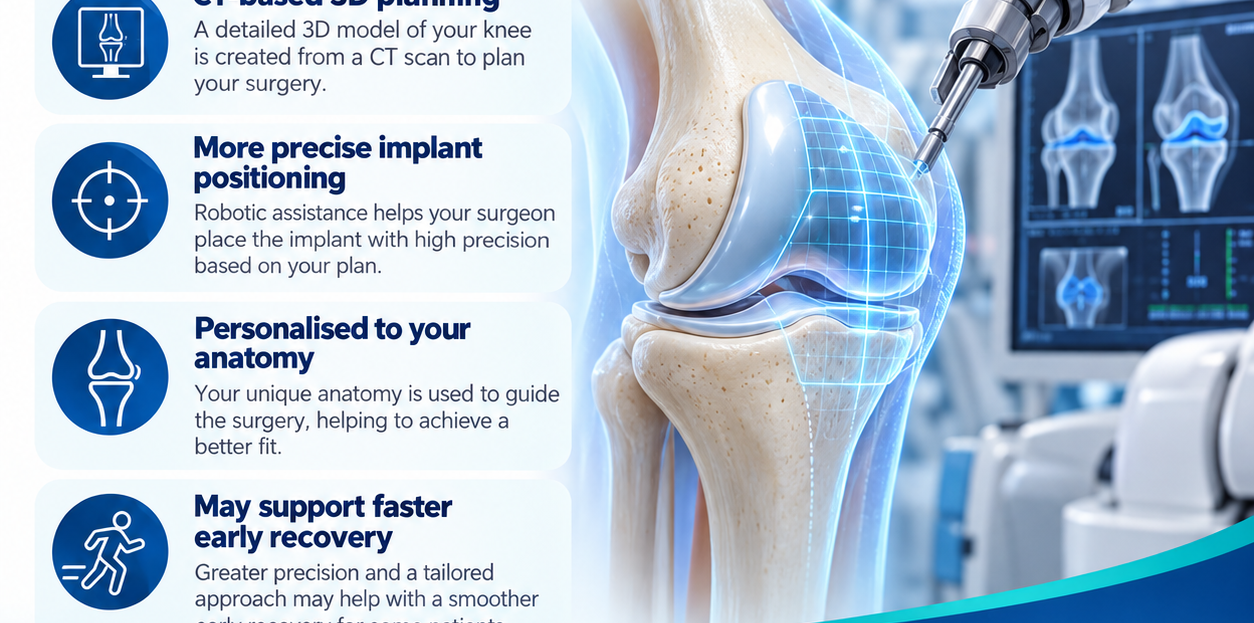
A CT scan is used to create a detailed 3D model of the knee. This helps the surgeon plan implant position and alignment for the individual patient. During surgery, the robotic system helps the surgeon work within those planned boundaries.
Potential advantages include:
• Greater precision in implant positioning and alignment
• More personalised surgical planning
• Greater control during bone preparation
• Potentially improved soft-tissue balancing
• In some studies, less early pain and faster initial recovery
However, robotic surgery does not automatically mean a better knee.
Current evidence suggests Mako can improve the accuracy of implant positioning, while overall patient-reported outcomes and complication rates may be similar to conventional knee replacement.
The surgeon’s experience, patient selection, rehabilitation and follow-up remain just as important.
Dr K. P. Kosygan is a UK-trained Consultant Orthopaedic Surgeon specialising in hip and knee replacement, including Mako robotic-assisted surgery, at Apollo Hospitals, Chennai.
Learn more:
https://www.rateddoctor.com/specialist/kornad-kosygan
#KneeReplacement #MakoRobotics #RoboticSurgery #Orthopaedics #RatedDoctor